Why baby teeth deserve care
Baby teeth usually start to appear at around six months, and most children have all 20 by about age three. They stay for years: the back baby molars often aren’t lost until around 10 to 12 years of age.
They help with chewing, clear speech and jaw growth, and each one holds a space open for the adult tooth forming underneath. Baby teeth have thinner enamel, so decay can spread quickly and lead to pain, infection and sometimes early loss of the tooth, which may let neighbouring teeth drift into the gap.
The usual culprits are frequent sugar, especially sweet drinks and grazing between meals, and bottles of milk or juice at bedtime. Plain tap water, which is fluoridated across most of Perth, is the kindest drink for teeth between meals.
A first visit by the first tooth or first birthday
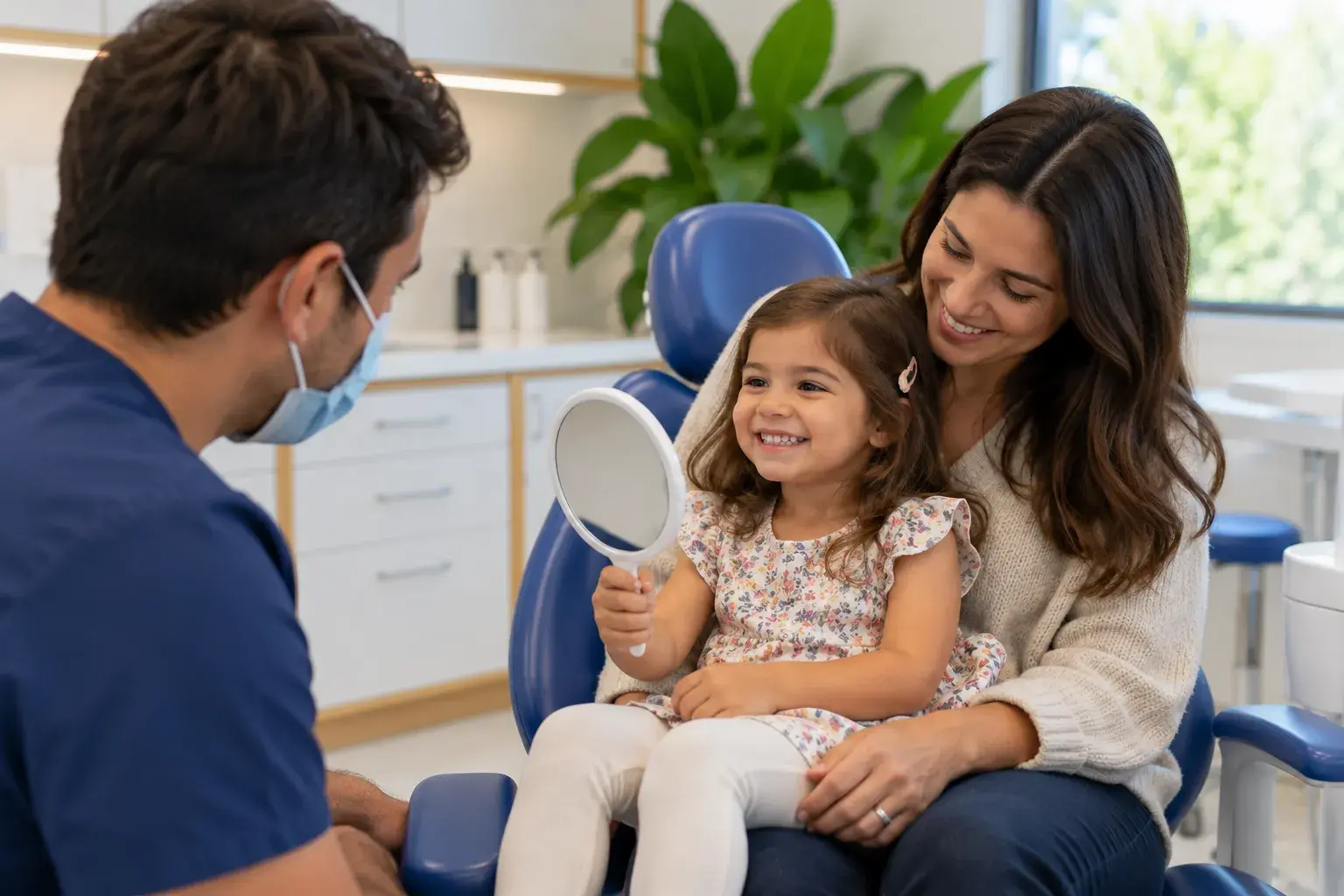
We suggest bringing your child in when their first tooth appears or by about 12 months of age, whichever comes first. At this age the visit is mostly for you: a quick look at teeth and gums, often with your child on your lap, and time to ask questions.
Coming in when nothing is wrong means the surgery becomes a familiar place rather than somewhere linked with toothache. After that, most children come for a check‑up about every six months, although your dentist may suggest a different interval.
Older first-timers are welcome too. If your child is four or nine and hasn’t been yet, we start the same way, slowly and with plenty of explaining.
Ready to book a visit?
Teething: what helps and what to avoid
Teething can make babies grizzly, dribbly and keen to chew. Sore gums are common, but teething isn’t thought to cause high fevers, diarrhoea or illness, so if your baby seems unwell, see your GP rather than putting it down to teeth.
- Rub the gums gently with a clean finger
- Offer a teething ring chilled in the fridge, not the freezer
- Let older babies chew on a cool, damp face washer
- Check with your pharmacist or GP before using teething gels or medicines
- Avoid amber teething necklaces and bracelets, which carry choking and strangulation risks
Toothpaste and brushing by age
Start cleaning as soon as the first tooth shows. Australian guidance on fluoride toothpaste changes as children grow:
- Birth to 18 months: a soft infant brush or damp cloth with water only, unless your dentist advises otherwise
- 18 months to 6 years: a pea‑sized amount of low‑fluoride children’s toothpaste
- 6 years and over: a pea‑sized amount of standard fluoride toothpaste
- Brush twice a day, morning and night, for about two minutes
- Encourage spitting out rather than rinsing, so some fluoride stays on the teeth
- Help with brushing until around age eight, when most children have the hand control to do it well
Sealants and fluoride for growing teeth
The first adult molars usually come through around age six, and the second around age twelve. Their chewing surfaces have deep grooves that toothbrush bristles struggle to reach, which is why decay often starts there.
A fissure sealant is a thin coating painted into those grooves and set hard with a light, leaving a smoother surface that’s easier to keep clean. It’s usually quick and needs no drilling or injection, but the tooth must stay dry for a few minutes. Sealants can wear or chip, so we check them at each visit and repair them if needed.
A fluoride varnish may be suggested for children at higher risk of decay, such as those with early white spots or braces. It’s painted on in seconds, and we’ll let you know how long to wait before brushing afterwards.
Thumbs, dummies and comfort habits
Sucking is a natural comfort for babies, and most children give up thumbs, fingers or dummies on their own somewhere between two and four years. If the habit continues once adult front teeth start coming through, usually from around age six, it can push teeth forward and affect how the upper and lower teeth meet.
Gentle encouragement tends to work better than pressure: praise, a sticker chart, or keeping hands busy at the times the habit usually happens. Never dip a dummy in honey or anything sweet, and avoid cleaning it in your own mouth, which can pass decay-causing bacteria to your baby.
Growing jaws, braces and sport
At each check‑up we watch how teeth are coming through and how the jaws are growing. Crowding, a large overbite, teeth that meet back to front, or baby teeth lost very early or very late can be signs that a closer look is worthwhile, sometimes with an OPG x‑ray to see the adult teeth still forming.
If treatment may be needed, we can refer your child to a registered specialist orthodontist, who will advise whether and when to start. Not every child needs braces, and for many the right time is once most adult teeth are through, although some bite problems are looked at earlier.
Children who play footy, hockey, basketball or other contact sports may benefit from a custom mouthguard, in colours they can choose. Our mouthguards page has more detail.
Help with costs through the CDBS
The Child Dental Benefits Schedule is a government program that can help with the cost of basic dental care for eligible children aged 0 to 17, generally where the family receives Family Tax Benefit Part A or certain other payments. It can cover services such as check‑ups, cleans, sealants and fillings up to a capped amount over two calendar years, but not orthodontics or cosmetic work.
We welcome CDBS-eligible children. Our health funds page explains how to check eligibility and any remaining balance.
Children’s dentistry, step by step
Questions about children’s dentistry
When should my child stop using a bottle?
Many children can start learning to drink from a cup at around six months, and moving off bottles by about 12 months is often suggested. Sipping milk or juice from a bottle for long periods, particularly at sleep time, bathes the teeth in sugar. If your child needs a bottle to settle, water is the kindest choice for their teeth.
My child has white or brown spots on their teeth. Should I worry?
Chalky white patches near the gumline can be an early sign of decay, while other spots may have formed while the tooth was developing. It’s worth booking a check so your dentist can tell which it is and what, if anything, needs doing.
Does a decayed baby tooth always need a filling?
Not always. It depends on how deep the decay is, how long until the tooth would naturally fall out, and whether it’s causing problems. Small early lesions may be managed with fluoride and monitoring, while deeper decay usually needs treating to prevent pain and infection.
An adult tooth is coming in behind a baby tooth. Is that a problem?
This ‘shark teeth’ look is common with the lower front teeth around age six. The baby tooth often loosens and falls out by itself, and the adult tooth then moves forward. If the baby tooth isn’t getting looser after a couple of months, or there’s pain, book a check.
My toddler fell and bumped a tooth. What should I do?
Comfort them and press gently on any bleeding with a clean cloth. Call us if a tooth is chipped, loose or pushed out of position, or if it turns grey over the following weeks. Never put a knocked‑out baby tooth back in, as this can damage the adult tooth forming underneath. For a knocked‑out adult tooth, follow the steps on our knocked‑out tooth page.
Can I stay in the room with my child?
Yes. Parents are welcome to stay, and for young children it usually helps. Some older children like to show us how grown‑up they are on their own, and that’s fine too.
What if my child is nervous?
Plenty of children are wary of new places. We go slowly, use simple words, let them hold the mirror and stop for breaks whenever they need one. A calm, matter‑of‑fact tone from you can make a real difference.