
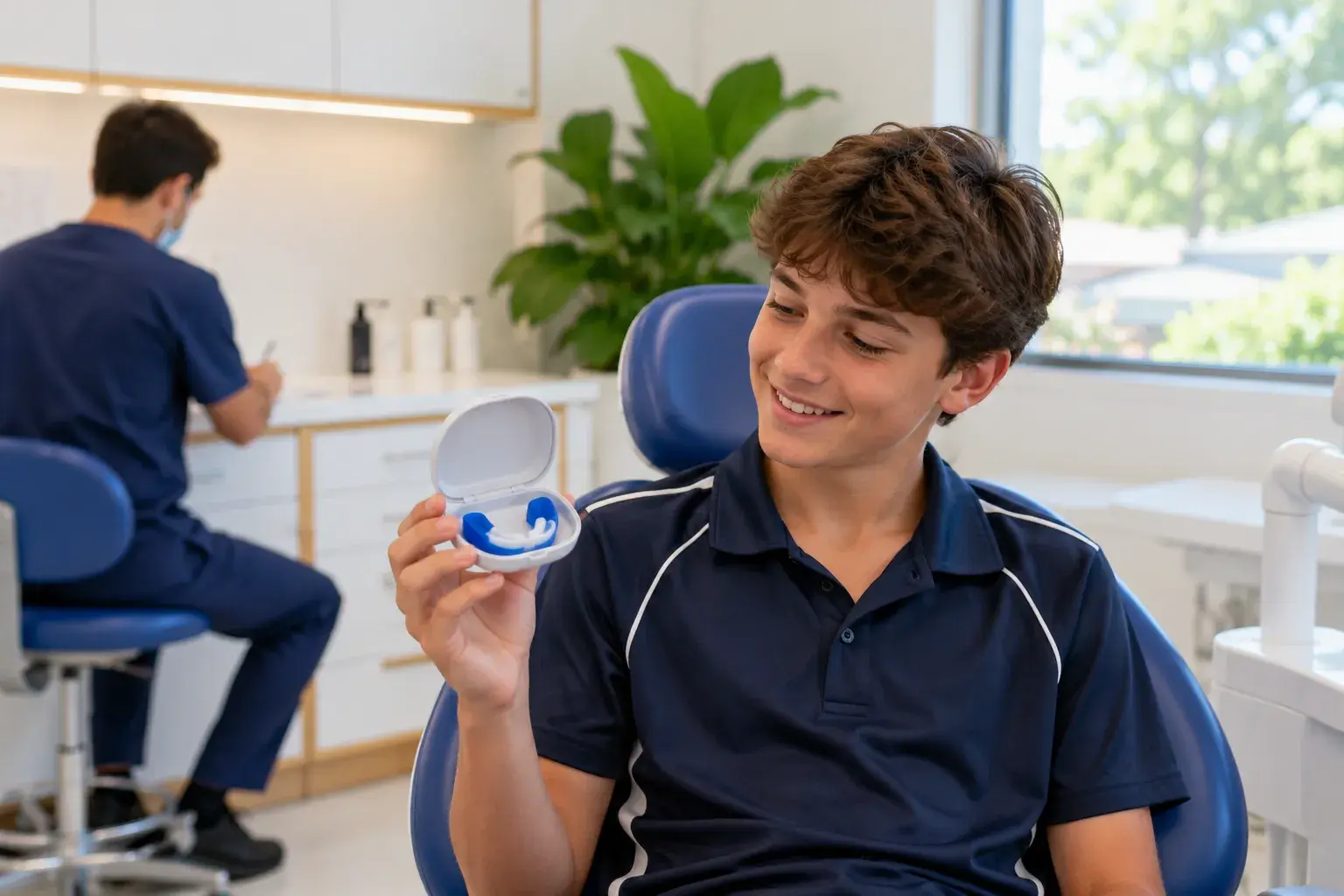
Which sports call for a mouthguard
Any sport where a ball, stick, elbow or the ground could meet your face carries a risk of dental injury. That includes Australian rules football, rugby, hockey, basketball, netball, soccer, cricket (especially batting or keeping without a helmet), water polo, martial arts and boxing, as well as skateboarding and BMX.
The Australian Dental Association recommends a custom-fitted mouthguard for training as well as games, as plenty of knocks happen at training. Junior players’ teeth are just as easily damaged as adults’, so it’s worth starting once a child takes up a contact sport.
Activities where falls are common, such as horse riding, trampolining and mountain biking, can also lead to dental injuries, so a guard may be worth considering there too.
How a mouthguard cushions a knock
A mouthguard is a layer of firm, shock-absorbing material over the upper teeth and gums. When there’s a blow to the face, it spreads and softens the force, which may reduce the chance of chipped, cracked or knocked‑out teeth and cuts to the lips and cheeks.
No mouthguard can prevent every injury, and it doesn’t replace a helmet or face cage where your sport calls for one. Fit and thickness both matter: a guard that’s too thin offers less cushioning, and a loose one may shift out of place at the moment it’s needed. Some clubs and schools require junior players to wear one, so it’s worth checking your club’s rules before the season.
Ready to book a visit?
Custom‑made versus boil‑and‑bite
Stock mouthguards from a sports store come in set sizes and are held in by biting down. Boil‑and‑bite guards are softened in hot water and shaped in the mouth, which improves the fit but can leave areas too thin where the wearer has bitten through, or too bulky over the gums.
A custom mouthguard is made on a model of your teeth, so the thickness can be controlled and the edges shaped to your mouth. Because it stays in place without clenching, many players find it easier to breathe, talk and call for the ball, and are more likely to keep it in for the whole game. A shop-bought guard is still better than nothing while you wait for a custom one.
Let us know if you have crowns, a bridge, implants, gaps from missing teeth or a blocked nose that makes mouth breathing hard, as these can all affect how the guard is designed.
Children, changing teeth and braces
Between about six and twelve, children lose baby teeth and gain adult ones, sometimes several in a year. A guard made around those teeth may need adjusting or remaking as the mouth changes, so we check the fit at each check‑up and let you know when it’s no longer snug.
Colour helps too. Younger players can choose from a range of colours, which can make a guard more likely to go to training rather than stay in the kit bag.
If you or your child wear braces, talk to us and your orthodontist before ordering. Teeth move during orthodontic treatment, so a guard may need a design that allows for brackets and movement, and it may need remaking more often.
Keeping your guard clean
A guard that’s looked after stays more hygienic and holds its shape for longer:
- Rinse it with cool water straight after use, and brush it gently with a soft brush and mild soap
- Let it dry fully before closing the case, so bacteria and mould don’t build up
- Store it in a firm, vented case rather than loose in a sports bag
- Don’t leave it in a parked car in summer, where the heat can warp it
- Avoid hot water and dishwashers
- Don’t chew or trim it, as that thins the protective layer
- Bring it to your check‑ups so we can look at the fit and any wear
When it’s time for a new one
Signs a guard needs replacing include splits, tears, bite-through holes, a loose or tight feel, or new teeth that it no longer covers. Children often need a new guard every season or so, while adults whose teeth aren’t changing may get several seasons from one if it isn’t damaged.
It’s also worth replacing after a change to your teeth, such as a new crown, a large filling, an extraction or orthodontic treatment. A guard that’s become discoloured or smells even after cleaning is also due for replacement.
After a knock to the mouth
Even with a guard in, a hard hit can chip, loosen or bruise a tooth. Check for broken edges, teeth that feel loose or sit differently, and a bite that doesn’t meet as usual.
A tooth that seems fine on the day can sometimes darken or become sore weeks later if the nerve inside was injured, so a check after any heavy knock is worthwhile. If a tooth is knocked right out, time matters: our knocked‑out tooth page explains what to do, and you should call us straight away.
Health fund cover and timing
Custom mouthguards are often claimable under general dental on extras policies, although limits and waiting periods vary. Your fund can tell you what you’ll get back if you give them the item number from your estimate. Some funds limit how often a mouthguard can be claimed, which is worth knowing for growing children who may need a new one each season.
Booking a few weeks before the winter or summer season starts leaves time for both visits.
Sports mouthguards, step by step
Questions about sports mouthguards
How far ahead of the season should we book?
Allow a few weeks to fit in both visits. If you’re also due for a check‑up, the impression can often be taken at the same appointment.
Should a sports mouthguard cover the lower teeth too?
Most sports mouthguards cover only the upper teeth, because the upper front teeth take most knocks and the lower jaw is braced when you bite on the guard. For some bites or sports, your dentist may suggest a different design.
My child says the mouthguard makes them gag. What can we do?
A custom guard is usually slimmer than a shop-bought one, which often helps. Wearing it at home for short periods, such as while watching TV, can make it feel normal before game day. If it still feels uncomfortable, bring it in so we can check whether it needs adjusting.
Can I use my sports mouthguard for grinding at night?
A sports guard is soft and thick, built to absorb impact, and isn’t designed for grinding. Some people end up chewing on a soft guard overnight, which can make clenching worse. If you grind or clench, ask about a hard night splint instead.
Can I drink during a game with it in?
Many players can take quick sips with a custom guard in place because it fits closely. Others prefer to take it out briefly. If you do, put it back in before returning to play.
Do adults playing social sport need a mouthguard?
It’s worth considering. A broken or knocked‑out adult tooth may need ongoing care, such as root canal treatment, a crown or an implant, over many years. If you play social footy, hockey, basketball or similar, a custom guard can help reduce that risk.