What makes this different from a standard denture
A conventional full denture stays in place through suction, the shape of your gums and the muscles of your cheeks and tongue. That works well for many upper dentures, but lower dentures in particular can float and move because there is less gum to sit on and the tongue keeps pushing against them.
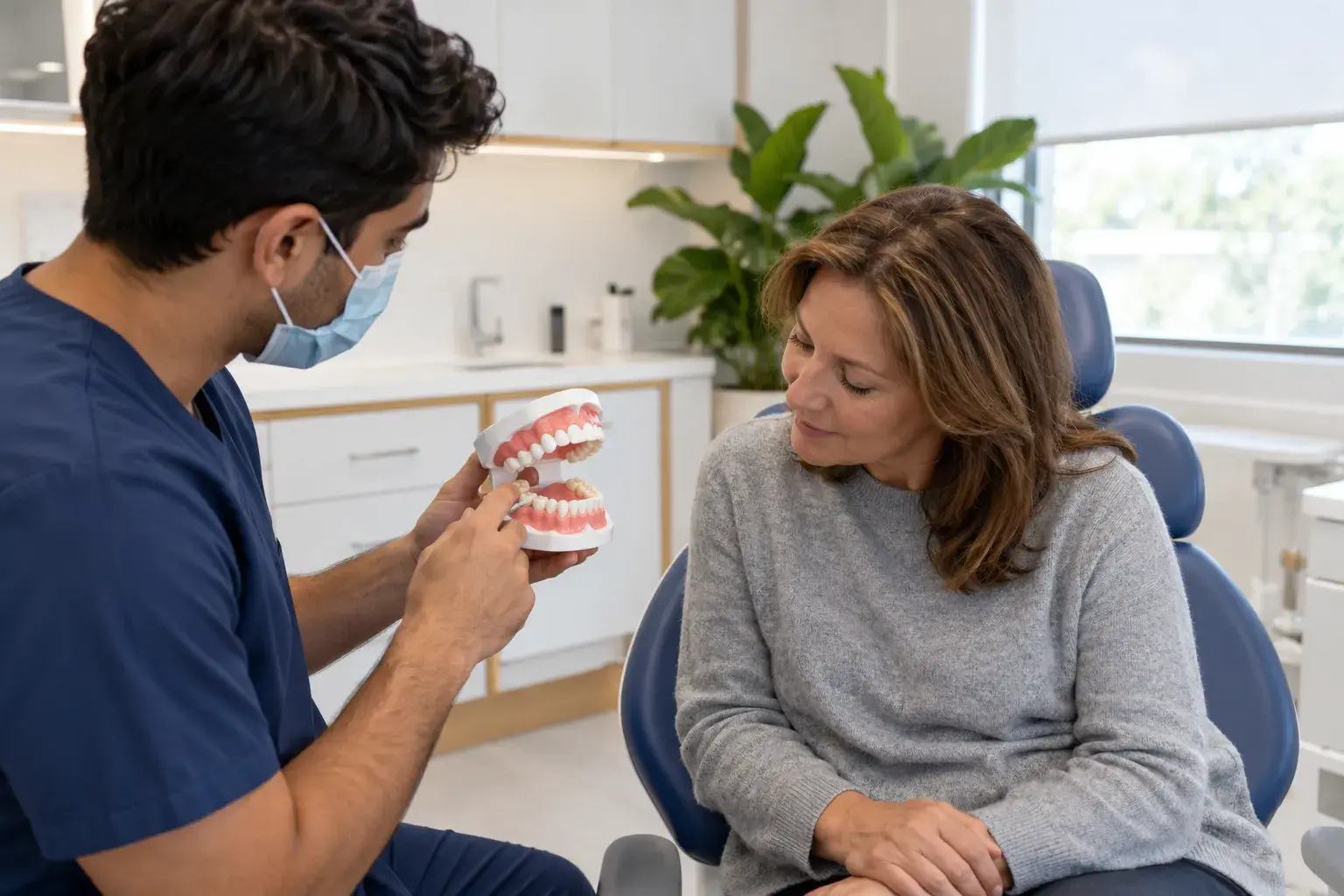
With an implant-retained denture, a few titanium implants are placed in the jaw and the denture connects to them. The implants act as anchors, so the denture is far less likely to shift when you talk, laugh or chew. This page covers replacing a whole arch of teeth. For a single missing tooth, see our dental implants page instead.
Removable overdentures
The most common approach is a removable overdenture. Small attachments are screwed into the implants, and matching fittings inside the denture press on over them like a press stud. Another design joins the implants with a slim metal bar that the denture clips onto.
You take the denture out each day to clean it and the implants, just as you would a regular denture. For the lower jaw, two implants are often enough to make a noticeable difference to stability. The upper jaw usually needs more, because the bone there is softer.
Ready to book a visit?
Fixed full‑arch options
In a fixed option, a full set of teeth is screwed onto several implants and only a dentist can remove it. It feels closer to having your own teeth, and nothing covers the roof of your mouth. It does generally need more implants, more bone and a bigger investment, and cleaning under it takes care and the right tools.
Fixed full-arch treatment is more involved to plan and may include a referral to a registered specialist in prosthodontics or oral surgery. If you are interested, your dentist can tell you whether your bone and health make it a realistic option and what the steps would involve. A fixed bridge is usually removed by the dentist from time to time so the implants underneath can be cleaned and checked.
Who these dentures may suit
People who tend to benefit most are those who already wear a full denture and find it loose, particularly a lower one, or who are about to lose their remaining teeth and want more stability from the start. Some people also find that a denture anchored to implants lets them eat a wider range of foods.
As with any implant, you need enough bone, healthy gums and reasonably good general health. Smoking, uncontrolled diabetes and some medicines affecting bone can raise the risk of problems. Good hand dexterity matters for removable designs, as the denture needs to be lined up and clicked on correctly each day.
If you have only a few weak teeth left, your dentist may talk about removing them and planning implants and a denture together, sometimes with an immediate denture worn while everything heals.
Stability and its limits
An implant-retained denture usually feels considerably more secure than a conventional one, but it isn’t the same as natural teeth. A removable overdenture can still rock slightly, especially on two implants, and very hard or sticky foods may still need to be avoided.
Sometimes your existing denture can be adapted to fit attachments, which can reduce cost. If it is old or worn, a new denture is often made at the same time. The implants themselves are surgical, with risks such as infection, nerve irritation, and an implant failing to bond, which your dentist will go through with you. We also check the teeth or denture in the opposite jaw, since a very steady lower denture biting against a loose upper one can bring its own problems.
Settling in with a clip‑on denture
Even with implants, there is a period of adjustment. Clipping the denture on takes some practice, and it helps to line it up over the attachments and press down evenly with your fingers rather than biting it into place, which can damage the fittings.
Because a lower overdenture is steadier when chewing, many people gradually return to foods they had stopped eating. Speech may settle faster than with a loose denture, as your tongue no longer has to hold it down. Sore spots can still happen, and the first review is the time to adjust them.
Caring for the implants and attachments
The implants need cleaning every day, even though they don’t decay. Brush around each one with a soft brush, and use interdental or single-tuft brushes under a bar. Clean the denture separately, paying attention to the fittings inside it.
The nylon inserts that grip the attachments gradually wear, and the denture loosens a little as they do. They are usually replaced from time to time at a routine visit, which is a quick job. The denture may also need relining as your gums change, and regular check‑ups let us look for inflammation around the implants early.
What affects the cost
There is a wide range, because no two cases are alike. The main things that change the fee are listed below. Implant work is usually claimed under major dental, where policies often have annual limits and waiting periods, so it is worth checking item numbers with your fund early.
- How many implants are needed and in which jaw
- Whether 3D imaging or bone grafting is required
- Removable attachments versus a bar or a fixed bridge
- Converting your current denture or making a new one
- Whether part of the treatment is done by a specialist
Implant‑retained dentures, step by step
Questions about implant‑retained dentures
Can my existing denture be used?
Sometimes. If your denture fits reasonably well and is in good condition, attachments can often be added to it. If it is worn or poorly fitting, a new one is usually made so the result isn’t limited by the old denture.
Do I take it out at night?
For removable overdentures, taking them out overnight is generally recommended to rest the gums and allow proper cleaning of the denture and implants. Fixed options stay in and are cleaned in place. Your dentist will give you a routine for your type.
How often do the clips need replacing?
It varies with how often the denture is removed, how you bite and the type of attachment. Many people notice the grip weakening after some months of use. Replacing the inserts is a short appointment and usually restores the hold.
Is it worth doing just the lower jaw?
Many people start with the lower jaw, because that is where conventional dentures tend to be least stable. An upper full denture often stays in reasonably well with suction alone, so it may not need implants at all.
Will I still need to visit the dentist regularly?
Yes. Regular check‑ups let us examine the gum around each implant, check the attachments and the bite, and reline the denture when your gums change. Problems around implants are easier to manage when found early.
What if one of the implants fails?
Occasionally an implant doesn’t bond or later loses bone support. Depending on the situation, it may be possible to place another implant after healing, or to adapt the denture to the remaining implants. We would talk through the options with you.